
As the global population ages, the digital transformation of home and institutional care has become an inevitable trend. Among various technological applications, fall detection and physiological monitoring are regarded as the two pillars of elderly safety. However, the proliferation of these technologies touches upon a sensitive ethical dilemma: when "safety" becomes the paramount principle, how can "privacy" coexist with technology?
Traditional image recognition technology has always faced significant resistance in caregiving scenarios. While visual data provides the most intuitive on-site assessment, it captures facial features, daily details, and images of private spaces. This often instills a strong sense of "being watched" in the monitored individuals, leading to psychological stress and social withdrawal.
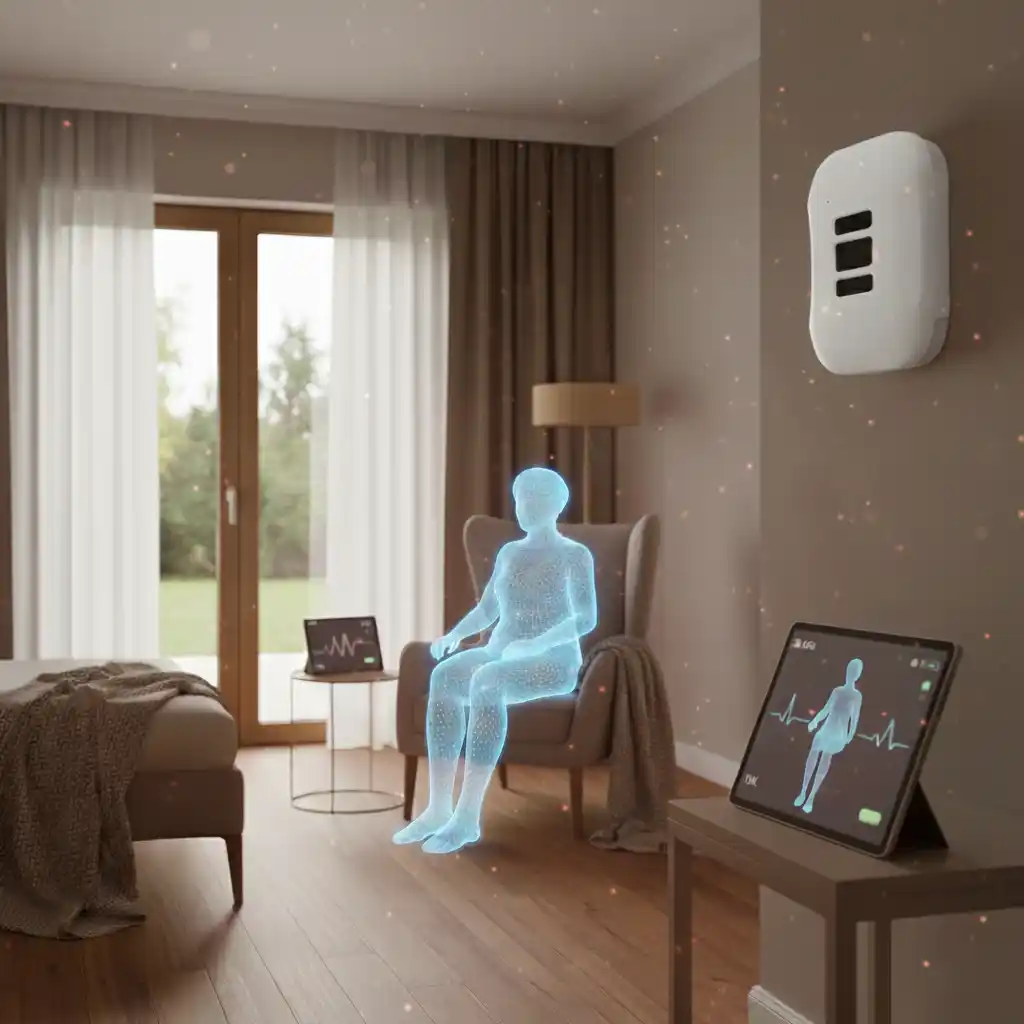
To mitigate this intrusiveness, the professional care sector is undergoing a technological revolution—moving from "visual reproduction" to "behavioral understanding." Technologies represented by 3D ToF (Time of Flight) Depth Sensing Cameras offer a key solution to this challenge. Unlike traditional cameras that capture colors and details, 3D ToF technology emits invisible light and calculates the flight time of the returning signal to construct a depth map of the space. This achieves "visual anonymity" at the physical level: the system presents de-identified silhouettes and movement logic rather than actual human imagery. This design ensures that in high-risk, highly private areas such as bedrooms and bathrooms, technology can "perceive" instead of "peer," safeguarding the psychological security of the care recipient.
Beyond the evolution of sensing mediums, the choice of data processing pathways is the technical core of balancing privacy and safety. Traditional cloud architectures require raw images to be uploaded for AI analysis; setting aside cybersecurity concerns, this is often cost-prohibitive in practice.
Professional-grade monitoring systems redefine data sovereignty through Edge AI. This means all complex behavioral interpretations—including identifying fall postures, analyzing stay durations, or detecting abnormal displacements—are completed instantaneously within the front-end device. The system only transmits low-bandwidth alarm signals and critical metadata when an "emergency event" is determined. This local processing architecture, where "data never leaves the premises," effectively prevents the risk of large-scale data breaches and achieves the goal of protecting personal information at the source.
In professional care practice, "false alarms" are often an invisible perpetrator of privacy infringement. Frequent false alerts force caregivers to intervene excessively, disrupting the daily rhythm of the care recipient. The precision of 3D ToF technology in spatial judgment effectively addresses this issue.
Compared to 2D imaging or single-point sensing, 3D depth information can more accurately calculate the relative position between the human body and the environment. Whether in total darkness during late-night bathroom visits or in a living room filled with furniture, the system can stably identify postural changes (such as a sudden transition from sitting to lying down). When technology can precisely distinguish between "intentionally lying down to rest" and an "unintentional fall," unnecessary surveillance intervention is minimized, achieving "protection without disturbance."
The ultimate goal of fall detection and physiological monitoring is not to transform living spaces into digital prisons. The application of advanced technologies like 3D ToF proves that the true point of balance lies in returning control and privacy to the monitored individuals while delegating professional judgment to ethically designed algorithms.
The future of care technology will move toward more invisible and de-identified directions. The highest ideal we pursue is "pervasive yet imperceptible"—where the gaze of technology is unfelt in daily life, yet becomes the most reliable lifeline in moments of crisis. Only when technology can gracefully recede into the background, appearing precisely when risks occur, do we truly realize the highest value of technology in safeguarding life.
Professional Advice: If you are considering implementing such systems in long-term care facilities or home environments, it is recommended to prioritize devices equipped with Edge AI and ToF technology. Additionally, ensure compatibility with back-end platforms supporting the ONVIF standard to guarantee data security and system scalability.

CIO of Merit LILIN and a 20-year veteran of the surveillance industry. Expertise spans from R&D in Edge AI cameras and cybersecurity to the development of award-winning VMS and NVR systems. With experience presenting in 34 countries and briefing top government officials on industry security, Steve combines global market insight with deep technical knowledge. Currently, he also leads industry-academia programs at NTUST, focusing on the advancement of AI technology and talent development.
 EN
EN  TW
TW