
To prevent surveillance cameras from becoming a "live streaming room" for hackers, the core strategy lies in establishing security thresholds at the source of hardware procurement and optimizing network architecture to hide devices behind a secure firewall.
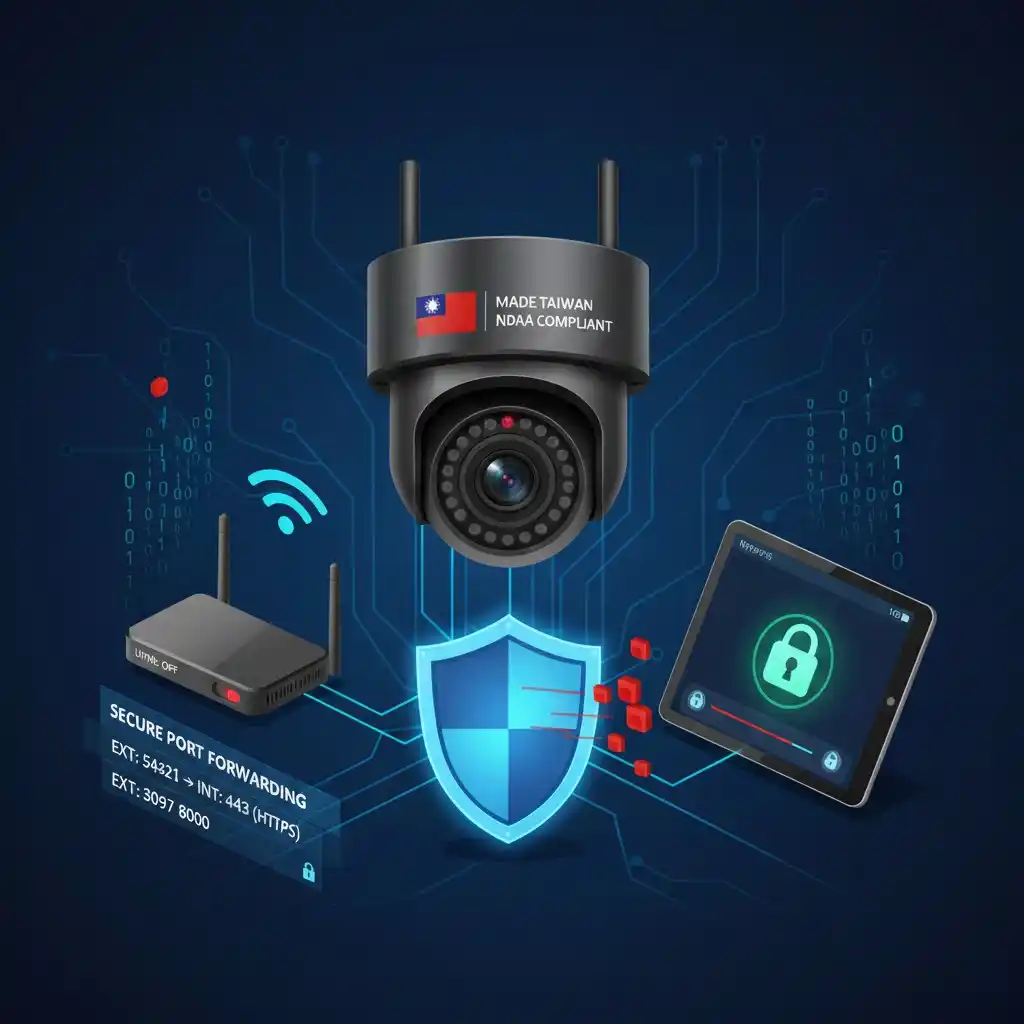
In today’s heightened security environment, choosing equipment that complies with NDAA (National Defense Authorization Act) and TAA (Trade Agreements Act) has become the standard for global financial and government institutions. These devices strictly prohibit the use of critical chips (such as specific SoC processors) from countries with security concerns, eliminating risks like hardware-level "backdoors" or unauthorized data transmissions.
Prioritizing Made in Taiwan (MIT) products not only guarantees stable hardware quality but also ensures that firmware and management software are developed by teams with strong cybersecurity awareness. This ensures transparency and traceability throughout the supply chain, significantly reducing the possibility of malware being embedded at the hardware level.
The most common entry point for hackers is scanning for devices that still use "default passwords." Modern high-end security systems should feature a mandatory password change upon first use, requiring complexity that includes uppercase and lowercase letters, numbers, and symbols.
Changing the password to a complex one immediately eliminates the majority of security threats; this is the single most important step to take once a device is deployed.
Additionally, enabling HTTPS encrypted connections ensures that even if video data is intercepted during transmission, it remains an unreadable string of code that cannot be reconstructed into an image.
If remote monitoring requirements necessitate Port Forwarding, strict hardening measures must be taken. First, UPnP (Universal Plug and Play) must be manually disabled. UPnP allows devices to automatically "punch holes" through firewalls to open unnecessary ports, which is often a primary cause of security breaches.
All communications should be configured manually, avoiding default ports (such as 80 or 8000) in favor of random, high-digit port numbers. Forwarding rules should be restricted to HTTPS ports to ensure all external transmissions are encrypted. The most critical defense is setting an IP White-list (IP Filtering) on the router, allowing access only to specific IP addresses. This ensures that while the door is "open," only those with a "valid pass" may enter.
Cybersecurity is a dynamic battle. Compliant security manufacturers continuously track international vulnerability reports (such as CVE) and release regular security patches. Users should establish a routine inspection system using the manufacturer’s scanning tools to ensure firmware is up to date. Promptly patching vulnerabilities is the final key to preventing a system from being compromised by outdated exploits after years of operation.
When you choose MIT-certified and NDAA-compliant equipment, combined with disabling UPnP and implementing a rigorous Port Forwarding strategy, your surveillance system transforms from a vulnerability into a robust line of defense.

CIO of Merit LILIN and a 20-year veteran of the surveillance industry. Expertise spans from R&D in Edge AI cameras and cybersecurity to the development of award-winning VMS and NVR systems. With experience presenting in 34 countries and briefing top government officials on industry security, Steve combines global market insight with deep technical knowledge. Currently, he also leads industry-academia programs at NTUST, focusing on the advancement of AI technology and talent development.


 EN
EN  TW
TW